
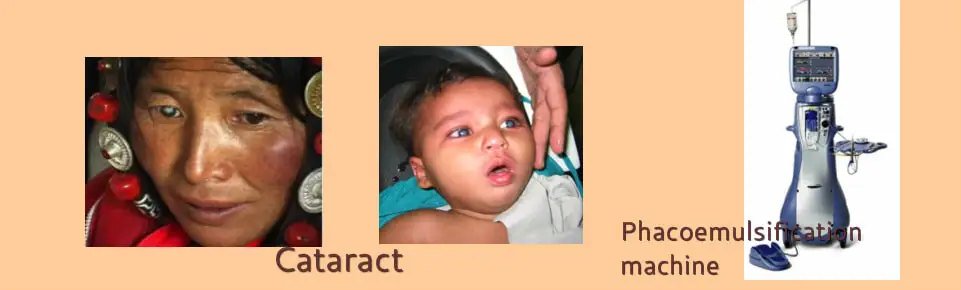
Cataract is a clouding of the natural lens of the eye. This prevents the passage of the light and makes everything look blurred and hazy.
Cataract is usually a disease of old age, but anyone can get it, especially after trauma or along with some other diseases such as Diabetes. Sometimes children may be born with a cataract (congenital cataract) or it may present in adolescence or early adulthood (Developmental cataract). Those on steroids are especially prone to develop early cataract.
Cataract can lead to decreased vision, glare, double vision, altered colour perception, haloes around lights and decreased contrast sensitivity. Cataract rarely causes pain or redness unless there is a complication.
Yes, Cataract is treatable by surgery. There is no known medical treatment for cataract.
In the early stages, the vision can be improved by a change in glasses. Anytime the patient feels that glasses are no longer adequate and feels hampered in their activities, surgery can be undertaken. Maturity of cataract is NOT a criteria. One should not wait for it to “ripen”
Yes, the longer we wait the cataract becomes mature and hardens. This makes the surgery more difficult later on. Also mature cataract can lead to secondary conditions like glaucoma, inflammation etc.
Surgical Options are:
1. Phacoemulsification or Micro Insicion Cataract Surgery ( MICS )
2. Femto Laser Assisted Cataract Surgery ( FLACS )
Phacoemulsification or Phaco is the most advanced technique of cataract extraction. In this method, the procedure is performed through a very small incision (2-3mm), so is also called Micro-incision cataract surgery or MICS. The instrument uses ultrasound vibrations to break the cataract into small pieces and with the help of vacuum all the pieces of the cataract are sucked out. A new lens, that is an intra-ocular lens (IOLs) is inserted into the eye. The surgery is completed without any stitches. This minimal incision allows faster and safer healing, hastening the return to normal activity.
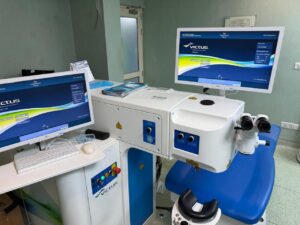
In FLACS there is further refinement of the technique. The incisions/openings are made by the Femto Laser which adds safety and precision to the procedure. It is especially useful in hard, mature cataracts and traumatic, fibrosed cataracts.
Intraocular lenses (IOLs) are different from contact lenses. During Phaco surgery, the IOL of appropriate power fitted inside the eye. The foldable IOls can be inserted through very small openings. These are made of high quality material .They unfold in the eye and are permanent and lifelong.
• Monofocal : Lens for distance only, reading glasses are required.
• Monofocal Plus or Advanced Monofocal : Lens is for distance correction and some amount of intermediate.
• Multifocal IOLs : Lens for both distance & near
• Trifocal lenses: Covering distance, intermediate & reading vision
• Toric IOLs : To correct preexisting cylindrical number
No, most of the cases can be done under topical anesthesia. In this, eye drops are instilled to anesthetize the eye and the procedure is done.
No injections required in most cases.
Since this is a sutureless operation, there are very few restrictions after the surgery. There is no need for bandages, green shades, dark glasses etc. There are no restrictions on eating and other activities. Eyedrops are prescribed which need to be applied for 4-6 weeks .
If a monofocal lens is used, you would need only reading glasses. However, if a Multifocal or Trifocal lens is used, the need for glasses is much reduced.
Since this is a minimally invasive surgery, the healing is very fast and thus there is almost immediate rehabilitation. There are no stitches so no pain or irritation. There are no restrictions and the patient can quickly return to a normal life.