Ptosis (Drooping Eyelid)

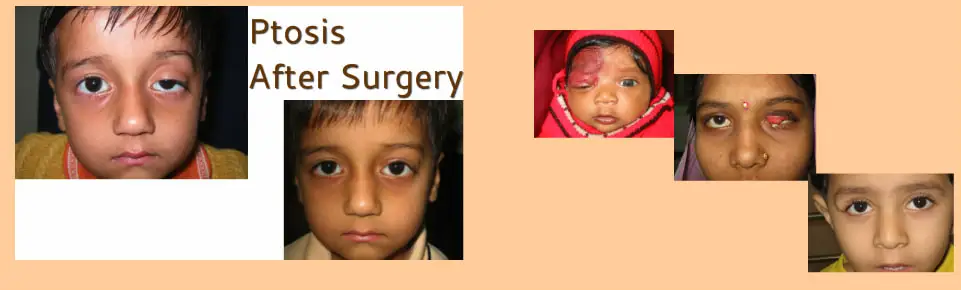
This refers to a droopy eyelid which may be one sided or both. The eye looks smaller and sometimes the person has a perpetually sleepy look. This patient is often born with ptosis, though the difference in the two eyelids becomes more apparent  when the child is 2-3 years old. Congenital Ptosis is correctable by surgery which is usually performed when the child is 4-5 years old.

Before
ptosis before - Dr Anita Sethi


After

Ptosis After- Dr Anita Sethi

Dacryo-Cysto Rhinostomy

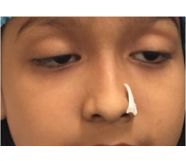
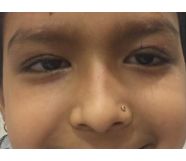
Congenital Naso-Lacrimal duct blockage ( Child with a watery eye)
Sometimes children have a watery sticky eye due to blockage of the pathway which drains the tears of the eye into the nose ( NLD ). In most cases the duct opens up by the time the child is 8-9months. One needs to keep the eye clean and massage as the doctor advises. In cases where it doesn’t spontaneously open by 1 year of age, a procedure of syringing and probing may be required.

NLD block in adults
Duct blocks in adults are usually due to infections. In the acute cases, it may be corrected by antibiotics. The chronic cases usually need surgical correction. This surgery is called Dacryo-cysto Rhinostomy ( DCR) and maybe done externally (conventional DCR), Through the nose ( Endonasal DCR) and using a Laser ( Laser DCR)

Eyelid Surgery

Eyelid malpositions (Entropion, Ectropion)
The eyelids may have malpositions like Entropion where the margin rolls in such that the eye lashes rub against the eyes and cause irritation. This needs to be surgically corrected since it can cause corneal irritation and infection.

The condition where the eyelid margin rolls out  away  from the eyball is called Ectropion. This may be due to injury, VIIth Nerve (Bell's) palsy or due to looseness of the eyelid caused by aging changes. It causes watering and redness of the eye, sometimes significant enough to require surgical correction.

Socket Reconstruction

Socket contraction/deformities may either be congenital or due to trauma/removal of eyeball because of tumour or gross disfigurement.The socket needs to be reconstructed, both in volume and area so that a good prosthesis fitting may be done.

Orbital Surgery

The orbital surgeries commonly performed are

  • Repair of blow-out fractures of the orbit
  • Orbitotomy: for biopsy/tumour removal
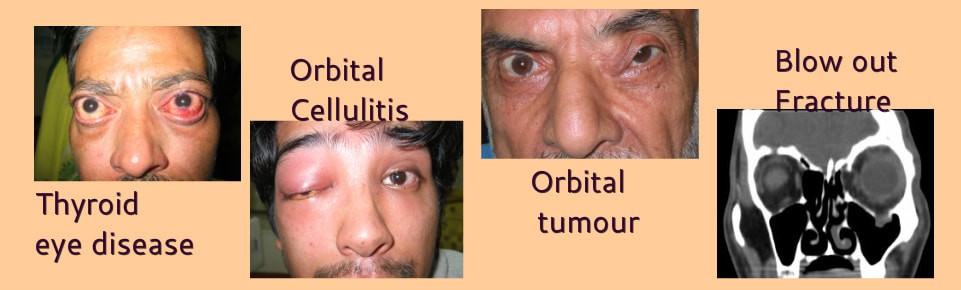
  • Decompression of orbit for Thyroid Eye Disease

Blow Out Fracture of orbit
This occurs when the orbit is struck by a blunt object such as a cricket ball/squash ball. The force of impact usually causes a fracture in the floor of the orbit and sometimes leads to entrapment of muscle and other tissue. Initially there is a lot of swelling and bruising, and as that subsides the patient may develop double vision due to muscle entrapment. In these cases surgical intervention is required to free the muscle and cover the defect with a plate.

Orbitotomy
This is a surgery performed for removal of tumours or mass behind the eye ball. This maybe done through the anterior, lateral or inferior route depending on the location of the lesion.

Orbital Decompression
This is usually performed for moderate –severe Thyroid eye disease, especially in cases not responding to or intolerant to steroids.